7 Gennaio 2015 - angela.reggi
2014 l’anno più caldo da sempre

It’s official: 2014 has taken the title of hottest year on record. That ranking comes courtesy of data released Monday by the Japan Meteorological Agency (JMA), the first of four major global temperature recordkeepers to release their data for last year.
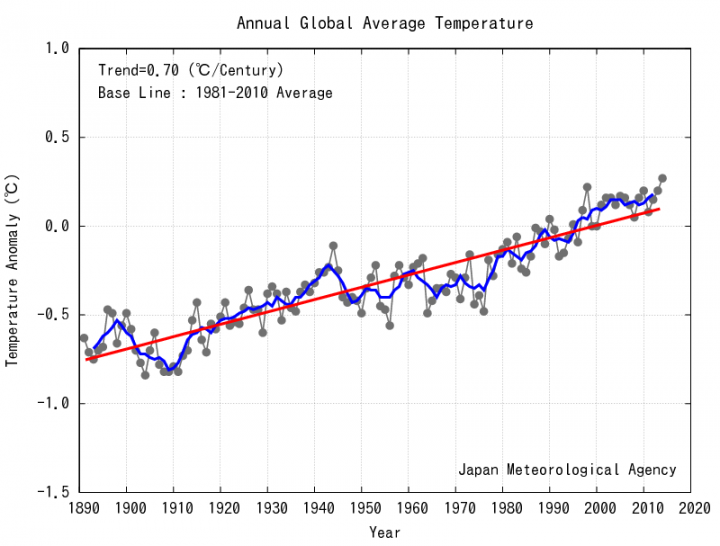 The global average temperature record from 1891-2014.
Credit: JMA
The upward march of the world’s average temperature since 1891 is a trademark of human-influenced global warmingwith 2014 being the latest stop on the climb. All 10 of the hottest years have come since 1998.
The average temperature was 1.1°F above the 20th century average according to JMA’s data. That edges 1998, the previous warmest year, by about 0.1°F.
Instead, record warmth in other parts of the Pacific as well as the hottest year on record in Europe were some of the main drivers in fueling the heat. Joe Romm of Climate Progress also notes that heat in Australia early in the year and California’s hottest year further contributed to the heat.One big difference between 2014 and 1998 is that the latter was on the tail end of a super El Niño, which has the tendency to spike temperatures. In comparison, 2014 was the year of the almost El Niño.
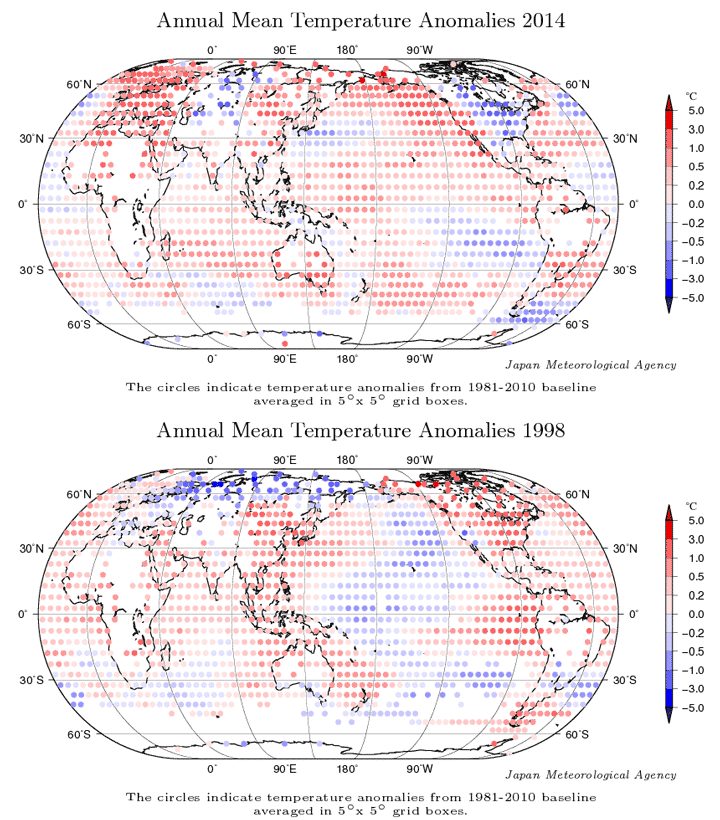 A comparison of 2014, the hottest year on record, and 1998, the previous record holder.
Credit: JMA
Seasonal temperatures also paint a picture of a planet that didn’t get a break. Spring, summer and fall were all record-setting hot. Last winter was the only season not to set a record, and even that was still the sixth-warmest winter.
JMA is one of the four major groups that use both ground measurements and satellites to compute the planet’s average temperature. The other three include NASA and the National Oceanic and Atmospheric Administration in the U.S. and the Hadley Center in the U.K. There are subtle differences in how they analyze temperature data, but there’sgenerally broad agreement, particularly the upward trend in temperatures over the past century.
The other groups are expected to release their data in the coming weeks and confirm that 2014 was indeed the hottest year on record. And some scientists think it could get even hotter sooner. Strong trade winds in the Pacific have likely had a dampening effect on the global average temperature by essentially allowing the ocean to store more heat, but those winds are expected to weaken in the near future as part of a natural fluctuation.
Link all’articolo originale
9 Settembre 2026
Come la Turchia bilancia decarbonizzazione e sicurezza energetica?

7 Settembre 2026
Carbon Footprint di Prodotto e ISO 14067: impara a quantificare e comunicare l’impronta climatica

2 Settembre 2026
Impact Report 2025: raccontiamo l’impatto di Aequilibria

31 Agosto 2026
Analizzare il rischio greenwashing nella comunicazione ambientale

27 Agosto 2026
ETS 2: scopri requisiti di compliance e impatti sulle strategie aziendali
20 Agosto 2026
Mobilità elettrica e Linee Guida UNECE per l’efficienza sistemica

18 Agosto 2026
Impatti sulla salute del cambiamento climatico: 24 settembre torna “Dialoghi sul Clima”
20 Luglio 2026
Come la Cina sta definendo il quadro di normazione “Dual Carbon”?

16 Luglio 2026
Come decarbonizzare la filiera della moda? Il caso Paris Good Fashion al 107° Tea Corner

1 Luglio 2026
Verso città libere dalla pubblicità fossile: il ruolo dei Comuni e degli standard tecnici.

4 Giugno 2026
Verifica e Validazione delle Emissioni GHG: fondamenti normativi e accreditamento
18 Maggio 2026
Corso Carbon Neutrality: come raggiungerla secondo la ISO 14068

6 Maggio 2026
ETS 2: la nuova scadenza per la Dichiarazione di Verifica è il 30 giugno 2026

30 Aprile 2026
EU ETS e carbon leakage: la tesi vincitrice dell’ultimo bando Tesi per il clima

28 Aprile 2026
Misurare e comunicare l’impatto sociale: perché è importante?

27 Aprile 2026
Santa Marta: la prima Conferenza internazionale sull’abbandono dei combustibili fossili

21 Aprile 2026
Corso CBAM & ETS: dalle regole alla readiness (III edizione)
15 Aprile 2026
ETS nel mondo: la nuova frontiera del carbon pricing globale al 104° Tea Corner

26 Marzo 2026
Corso self-paced sulla Carbon Footprint of Products: come applicare la ISO 14067?
17 Marzo 2026
Corso CBAM: dalle regole alla readiness per la fase definitiva | Mercoledì 1° aprile